

We are deep into this off-season series focusing on what the Chiefs’ hiring of Eric Bieniemy can bring to their offense this upcoming season. In part 1, we focused on the Chiefs’ and Bears’ primary run concept — the Wide Zone — and how the running backs can improve under Bieniemy. In Part 2, we took a look at how the plays were designed specifically from a tight end assignment and motion standpoint. Fixing those details around the Chiefs’ Outside/Wide Zone Run game should allow them to find more success on their primary run concept.
The next hurdle is what they decide to pair with that Outside Zone run game to maximize the rushing attack. Most teams will have a primary run concept that they have numerous variations of with different formations, different aiming points, and execution. They often have another one or two run concepts that will be secondary run concepts that they will still run frequently, but not quite as often. After that, you get into ancillary run concepts that will be far more match-up dependent or designed entirely to hit a big play; think of these more like passing game shot plays downfield.
For Part 3 of this series, we are going to focus on those secondary run concepts and how to maximize their impact, specifically with Outside Zone being the primary concept.
What Bieniemy Can Bring: Expanding the Run Menu
There are two main approaches to building out a run menu. There is option A, which is going to settle as many runs in the same general family, so the rules, techniques, and coaching points can be very familiar. This would be like running almost exclusively Outside Zone, Inside Zone, Mid Zone, and any other zone run you can think of. Option B would be picking a run concept that is the polar opposite of your primary run concept to force defenses into reading two entirely different processes. Neither one is right nor wrong, but the top rushing attacks in the NFL are trending towards the second option.
What’s on the Menu
The 2025 Chiefs primarily leaned into Option A above. Their second most common run play was an RPO run, and third was Inside Zone. Those RPO runs were predominantly Inside or Outside Zone calls for the run option as well. That means the Chiefs’ top 3 run plays were all in the same general “zone” family. Let’s table the RPO talk for now and turn towards the efficiency. They were actually more efficient running Inside Zone than outside Zone by posting a -0.018 EPA/play compared to -0.198 EPA/play.
The Bears under Bieniemy were a team that operated more towards Option B. While Inside Zone was their second most common run, Duo was third and right on its heels. Duo is a gap scheme run that’s about as downhill a run as one can run after short-yard Iso concepts. The Bears saw a dip in efficiency on their Inside Zone runs compared to their primary Outside Zone attack, but their Duo run efficiency landed at +0.136 (+0.114 on Outside Zone).
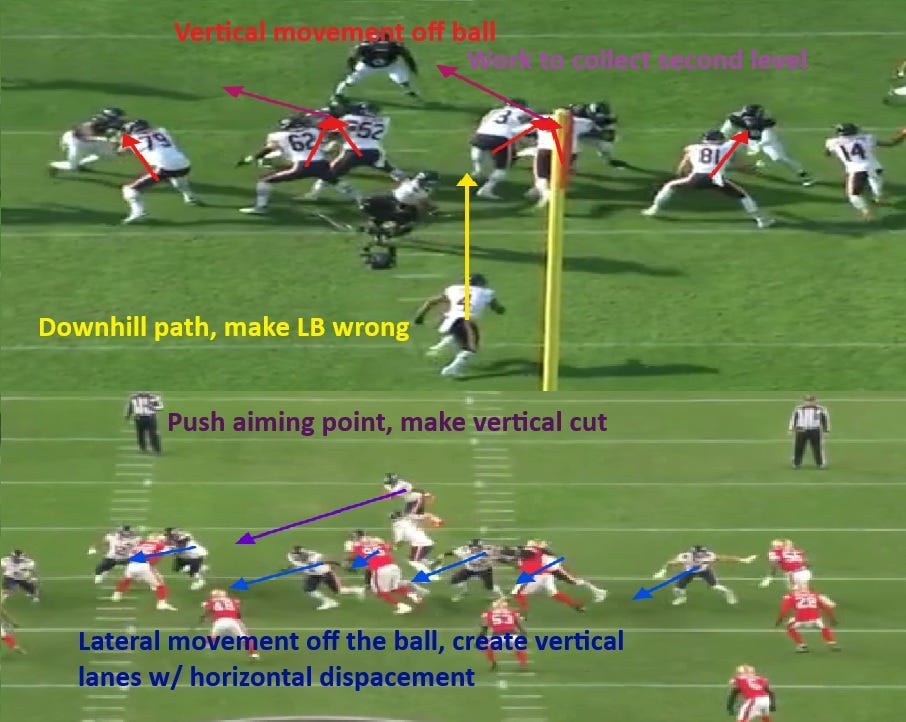
This variety in their run game slows defenses down as they're now concerned with flowing quickly towards the sideline to match the Outside Zone or coming downhill to meet blockers on a Duo rush. These small advantages may only equate to a few steps a few times a game, but that’s a massive difference in the NFL.
Get Downhill
Similar to our zone run articles in previous weeks, this isn’t intended to be a Duo run breakdown but rather just an emphasis on what the goal is. Still, it’s helpful to have an understanding of what Duo consists of, so a quick crash course:
The goal is to get as many double teams as possible at the line of scrimmage
This is accomplished by running to the tight end or the strength of the formation
The double teams then work up to the second level when possible, but not to the detriment of first-level vertical movement
The center is typically going to work to the weakside of the formation or away from the run direction
The entire OL is responsible for their “backside gap” first and foremost
The play side double team is working to the play side linebacker, but looks to block him if he runs into them
The running back’s aiming point is at the play side linebacker and reads him
The RB is going to cut away from whichever side the LB attacks of the double team
It’s his job to bring the linebacker to the block