

New Year. New Bieniemy. New Offense? Pt. 2
Part 2 of a series looking at what the Chiefs new, returning OC can bring to the 2026 Chiefs' Offense with improved play design on Wide Zone run concepts.

Last week, we kicked off a new series looking at what the returning Eric Bieniemy can add to the Chiefs’ offense based on his experience with the Chicago Bears. It’s understood that this is always going to be Andy Reid’s offense, but there certainly are things Bieniemy can bring over from his time as the running backs coach under Ben Johnson, specifically as it pertains to the run game. The first of the series focused directly on the running backs and how they operate on a Wide Zone run play — the most common run for the Chiefs and the Bears last year — due to Bieniemy’s direct control over that aspect.
This week, we will stay in that same neighborhood and focus on some schematic elements of how the Wide Zone run is structured. This traditionally would fall under the umbrella of the "Run Game Coordinator” for a team; Bieniemy could still have a pretty big role in how the run game is designed in Kansas City because he has handled that role before. Without further ado, let’s jump into some schematic adjustments that could be coming to the Chiefs’ Wide Zone Rushing attack.
What Bieniemy Can Bring: More Creative Wide Zone
Last week, we broke down the Chiefs’ top run play, which was Outside Zone, and the majority of those were Wide Zone runs from under center vs true Outside Zone from shotgun. The focus was on the running back’s footwork and reads for that article, and this week, we are transitioning to a larger, entire offensive viewpoint of the play.
There were numerous reasons the Bears were more successful on their Wide Zone runs than the Chiefs last year, but one of the main reasons — outside of the talent at running back — could simply be how much cleaner it was designed.
Blocking Wide Zone
This isn’t an intensive breakdown of how to block Wide Zone. For the purpose of this article, we are going to keep it incredibly simple and focus more on the “window dressing” of the play and what is being asked of the tight ends. Still, the basics are good to know, so from a very simplistic standpoint:
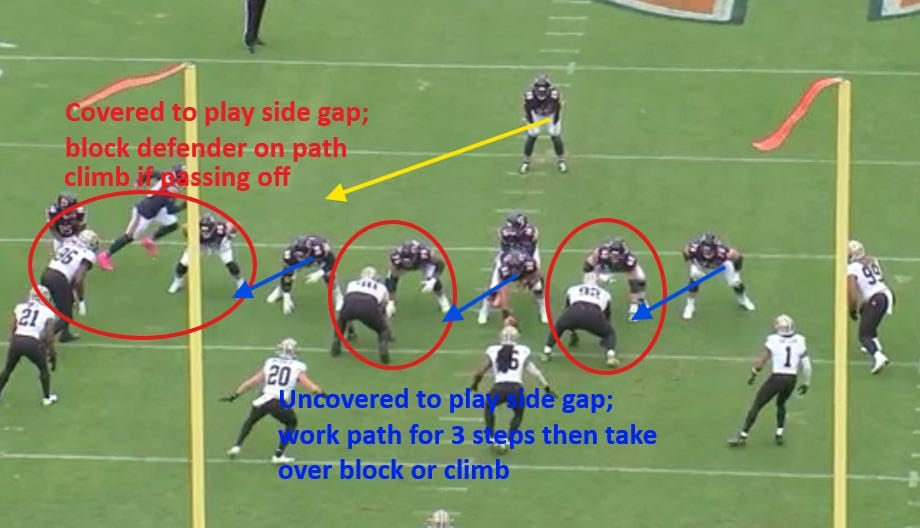
Covered Offensive Lineman - there is a defender directly over your head or in the immediate gap to the direction of the run play.
The goal is to get your knee into the crotch of the defender in the gap, your head into their outside armpit, and your backside hand into the chest.
The goal is to reach this defender and work your hips across their body and either A) pass them off to the next offensive lineman or B) drive them on your path off the line of scrimmage.
Uncovered Offensive Lineman - there is no defender directly over your head or in the immediate gap in the direction of the play.
You have 2 to 3 steps to determine if you are taking over the block of the nearest play side defender or climbing to the second level.
Aim for the near knee of the nearest defender, if contact is made on the second step take over the block. If no contact is made, snap — think stiff arm — the defender and transition to climbing to the second level.
Combination Blocks - Blocks in which two offensive linemen work together to block one defender on the first level, and then one offensive lineman climbs to the second level to engage a new defender.
There are various play-side and back-side combination block calls for offensive linemen with the goal of getting as many combination blocks on a given play as possible.
Again, this is a very crude rundown of general Wide Zone blocking, but it gives us a baseline for understanding what is happening on the play. Now it’s time to move on to the window dressing.
Utilizing Motion on Wide Zone
Let’s rip the analytics band-aid off right away. The Chiefs run Wide Zone with motion at the snap 46% of the time and average 0.26 yards less per rush on those attempts. The Bears, with Bieniemy as RB coach, ran motion on their Wide Zone runs 56% of the time and averaged 0.87 yards more per rush on those plays. The Bears not only utilized motion on Wide Zone runs more often but were more effective when doing so.
Beyond the volume of motion, this tells us there is also a quality component as well. The majority of the Chiefs’ motion at the snap on these plays were either a tight end coming across the formation for a Slide route — a short flat route after bluffing a block on the backside defensive end — or them getting man or zone coverage tells at the snap. The Bear,s on the other hand, incorporated various motions from fast tight end motions changing the strength of the formation, receivers working into the backfield/sniffer positions, jet motions, and anything else they could think of to keep defenders guessing.