

New Year. New Bieniemy. New Offense? The Final Chapter
For the season finale, let's take a deep dive into play-action passing and how the Chiefs' new, returning OC can bring it up to snuff.

It’s been a full month now, and it’s time to bring this fun New Offense series to an end. So far, we’ve talked about how Eric Bieniemy’s arrival could help the Chiefs’ running backs on Outside Zone runs, how he can help spruce up some rules in the run game, and how they can improve the run menu available to them. We’ve gone from the most concrete idea in Bieniemy’s direct impact on the running back room to something quite abstract, like his ability to overhaul the run concepts the team utilizes. It’s time to take it a step further now and get all the way out of the box.
That’s right, we are moving away from the run game and for this final piece we are going to focus on the passing game… well specifically the play-action passing game. The reason this is being considered the most abstract or theoretical is simply that it requires a profound change to the overall identity of the Chiefs’ offense. What they have built over the past eight years is a passing attack that is not reliant on play-action passing. At the end of the day, this is still going to be Andy Reid’s offense, and while Eric Bieniemy can come in and help fine-tune various areas of it, it still has to fit what Andy wants to do at the end of the day.
That doesn’t mean there is no room for improvement or that Andy Reid won’t be receptive to new ideas. For that reason, it’s time to dive into the film room for one last ride on the New Year. New Bieniemy. New Offense? series and look at how the Chiefs can improve their play-action passing game.
Play-Action Passing
Since 2022, the Chiefs have been under a steady decline in terms of play-action passing efficiency. For Patrick Mahomes’ first five years starting in the NFL, they continually ranked top five in either (or both) yards per pass and EPA/pass off play-action. Over the past three seasons, they have fallen to the middle of the pack, being ranked between 13th and 17th.
There are countless reasons that could play a part in that fall, but one we won’t entertain here is the “lack of run game success”. It’s something that has been studied, and there is a marginal correlation between successful run games equating to good play-action passing and vice versa. Getting that out of the way, we can now dive into some of the main causes of the Chiefs’ play-action passing game and how they can be fixed independently of how successful the run game is or isn’t.
Get Under Center
The theme for this entire series has clearly been get under center more often. From the primary run game to the secondary run concepts and now play-action passing, it’s simply more effective in the modern NFL to utilize under-center concepts more frequently than the Chiefs currently do.
League-wide, there were nearly 1.5x play-action passes from under center than there were from shotgun. On those plays, both the yards per pass and EPA/play were better from under center — 8.36 yards per pass and 0.238 EPA/play to 7.88 yards per pass and 0.205 EPA/play. It’s pretty apparent that even with a bigger sample size, under-center play-action was more effective than shotgun play-action, so surely the Chiefs followed that trend… right?
Not exactly. The Chiefs were more effective on under-center play-action plays, averaging 0.207 EPA/play, but ran them significantly less often than they did shotgun play-action concepts, in which they only averaged 0.120 EPA/play. The Chiefs ran 106 play-action concepts from shotgun to only 43 from under center. The Chicago Bears were oddly opposite, focusing vastly more on under-center play-action plays with 176 for a 0.135EPA/play and only 24 shotgun play-action plays with a 0.328 EPA/play.
The Bears with Bieniemy on staff were following the NFL’s trend of heavier usage of under play-action despite having lackluster results, whereas the Chiefs followed the efficiency trend but simply refused to lean into it more frequently.
Why Does it Matter?
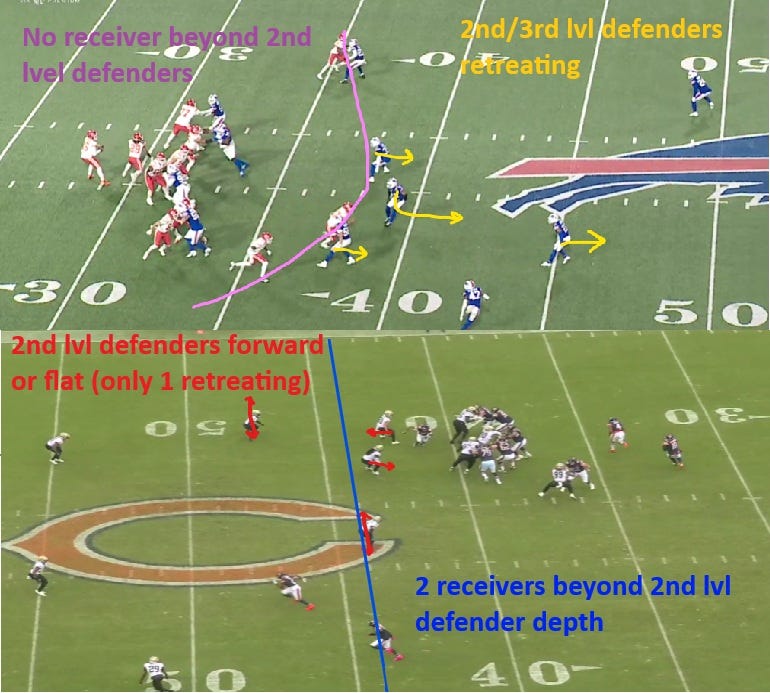
It sounds subtle, but the most obvious difference is how hidden the run-action becomes from under center. With the quarterback having to turn towards the running back and move away from the defense, the run-action is less visible compared to a shotgun formation, with everything happening right in front of their eyes. This causes more hesitation or buy-in from defenders respecting the run-action and allows routes to get on top of the defense easier.
Below is a picture of the Chiefs utilizing a shotgun play-action concept and the Bears utilizing an under-center play-action concept. Both pictures are taken one step after the run-fake is finished, so we can see the impact the run-action had on the defense and the route combinations.
There is also an element of opening the run concept menu for the play-action plays. What this means is rather than consistently running play-action with the offensive line setting like it’s Inside Zone from shotgun, the offensive line can set up their protection off multiple run concepts. This extra layer also causes a defender to have to diagnose what type of run vs a pass play rather than simply knowing the run concept and keying only on who keeps the ball.